
Sigismund of Luxembourg
King of Hungary and Bohemia and subsequently emperor. His involvement in the Great Schism, the Hussite Wars and the Council of Constance made him a central figure in fifteenth-century Europe.
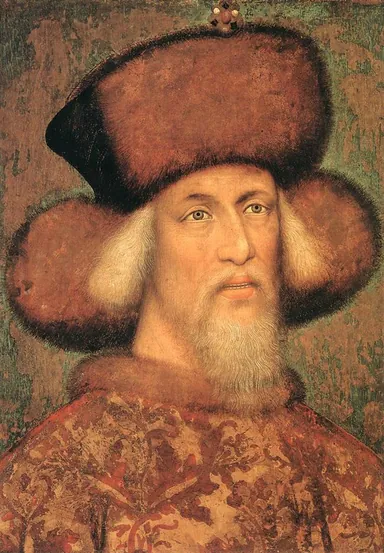
Life of Sigismund of Luxembourg
King of Hungary through marriage
The younger son of Emperor Charles IV, he was born in Nuremberg in 1368. Betrothed to Mary, daughter and heiress of Louis I of Hungary, he was crowned King of Hungary in 1387 after a succession crisis in which the queen was held prisoner. He governed a kingdom with a powerful nobility, which even imprisoned him in 1401.
References: Deutsche Biographie · Encyclopaedia Britannica
Facing the Ottomans
In 1396 he led the crusade destroyed by Bayezid I’s Ottomans at Nicopolis; Sigismund escaped along the Danube. He subsequently organised the defence of the southern frontier through fortresses and alliances, including one with the Serbian despot Stefan Lazarević, and in 1408 founded the Order of the Dragon with his wife Barbara of Cilli.
References: Deutsche Biographie · Encyclopaedia Britannica
Constance and the Hussite crisis
King of the Romans from 1410–1411, he promoted the Council of Constance (1414–1418), which ended the Western Schism by electing Martin V. The council condemned and burned Jan Hus despite the king’s safe conduct. When he inherited Bohemia (1419), the Hussite Wars broke out, and he was not accepted in Prague until 1436.
References: Deutsche Biographie · Encyclopaedia Britannica
The last Luxembourg
Crowned emperor in Rome in 1433, he died in Znojmo in 1437. With no sons, he left his inheritance to his daughter Elizabeth and son-in-law Albert of Habsburg, who was elected King of Hungary, Bohemia and the Romans. Sigismund’s death ended the male Luxembourg line.
References: Deutsche Biographie · Encyclopaedia Britannica
This complete profile is available in English. Bibliographic titles retain their original language. Links marked ES open the Spanish edition.
Key details
Birth: 15 February 1368 Documented
Death: 9 December 1437 Documented
Role: Emperor
Dynasty: Luxembourg · ES
Territories: Germany (ES) · Hungary (ES) · Bohemia (ES) · Holy Roman Empire (ES) · Croatia (ES) · Moravia (ES) · Silesia (ES)
Recorded relationships
Their titles over time
Follow the changing territories and offices of Sigismund of Luxembourg. Each title retains its own status.
Governments in 1420
- Crown of Saint Stephen2 titles and offices
View titles and jurisdictions
- Hungary · ESKing · Co-ruler1387–1437 · Shared authority; not treated as an exclusive succession.
- Croatia · ESKing · Co-ruler1387–1437 · Shared authority; not treated as an exclusive succession.
The kingdoms of the Hungarian crown and, before its eastern separation, the voivodeship of Transylvania. Each title retains its identity; an independent Transylvanian prince or an Ottoman tributary is not included merely because of a shared ruler or proximity. Source for this grouping
- Holy Roman Empire (Germany)King of the Romans
View titles and jurisdictions
- Germany · ESKing of the Romans · Effective rule1410–1437
- Crown of Saint Wenceslaus3 titles and offices
View titles and jurisdictions
- Bohemia · ESKing · Effective rule1419–1437
- Moravia · ESMargrave · Effective rule · Royal centres of Brno and Olomouc; regional authority over the margraviate, distinct from the full geography of the Bohemian title1419–1422 · Brno and Olomouc are regional urban centres; they are not equated with the monarch’s exclusive ownership of Moravia and do not erase seigneurial or episcopal jurisdictions. Olomouc begins with the privilege of 1378 and is excluded during the documented Swedish and Prussian occupations.
- Silesia · ESSovereign · Effective rule · Overlordship of the Bohemian crown over the Silesian duchies; not direct ducal possession1420–1437 · The enfeoffed princes and the bishop of Nysa retain their own governments. The area represents superior sovereignty; Schweidnitz-Jauer was incorporated in 1392. Greater Poland, Lusatia and Glatz are excluded. This does not derive from the imperial office.
The Lands of the Bohemian Crown (Corona regni Bohemiae), constituted by Charles IV in 1348 and placed under Saint Wenceslaus’s patronage: the Kingdom of Bohemia, the Margraviate of Moravia and the Silesian duchies effectively governed by this person. Provincial titles are retained; Prussian Silesia is not assigned to a Habsburg monarch. Source for this grouping
Annual dates: overlap within one year does not prove that two offices were held on the same day. Regencies and co-rulerships retain their labels.
Sources for this profile
- Polska Andegawenów · Plataforma educativa del Ministerio de Educación de Polonia
- Museo de Historia de Polonia · Jadwiga, entrevista con la historiadora Jadwiga Krzyżaniakowa
- Christopher Mielke · The Archaeology of the Medieval Queens of Hungary, tesis CEU (2017)
- Pál Engel · The Realm of St Stephen: A History of Medieval Hungary, 895–1526
- Robert Frost · The Oxford History of Poland-Lithuania, volumen I
- Deutsche Nationalbibliothek · GND authority record · Sigismund, Heiliges Römisches Reich, Kaiser
- Encyclopaedia Britannica
Biographical and contextual references in their original language. Sources and methodology.
Evidence for this profile
13 recorded claims · 4 without a claim-specific source. Context references do not by themselves verify every fact.
Dates (2/2 with a precise source)
- BirthDocumented
15 February 1368
The authority record gives the birth as 1368-02-15. - DeathDocumented
9 December 1437
The authority record gives the death as 1437-12-09.
Family and relationships (4/4 with a precise source)
- FatherDocumented
Charles IV of Luxembourg
The authority record identifies Charles IV of Luxembourg (GND 118560085) as father. - MotherDocumented
Elizabeth of Pomerania
The authority record identifies Elizabeth of Pomerania (GND 189559918) as mother. - Marriage or partnershipDocumented
Mary I of Hungary
The authority record identifies Mary I of Hungary (GND 132134454) as spouse. - Marriage or partnershipDocumented
Barbara of Cilli
The authority record identifies Barbara of Cilli (GND 119334224) as spouse.
Governments (3/7 with a precise source)
- GovernmentPending review
King · Hungary · 1387–1437
A precise source has not yet been added. - GovernmentPending review
King of the Romans · Germany · 1410–1437
A precise source has not yet been added. - GovernmentPending review
King · Bohemia · 1419–1437
A precise source has not yet been added. - GovernmentDocumented
Emperor · Holy Roman Empire · 1433–1437
The authority record dates this office to 1433–1437. - GovernmentPending review
King · Croatia · 1387–1437
A precise source has not yet been added. - GovernmentInferred
Margrave · Moravia · 1419–1422
Brno and Olomouc are regional urban centres; they are not equated with the monarch’s exclusive ownership of Moravia and do not erase seigneurial or episcopal jurisdictions. Olomouc begins with the privilege of 1378 and is excluded during the documented Swedish and Prussian occupations.Instituto de Historia de la Academia Checa · Jiří-Joseph Veselý · Biografický slovník českých zemí 1 (2004), pp. 55–56: Sigismund grants Moravia to Albert as a fief in October 1423; submission in 1424; this is earlier than his Bohemian kingship of 1438.Brno City Archives · Brno v minulosti a dnes 4 · Taxation of Moravian royal towns: Brno, Znojmo, Jihlava and Olomouc; interregnum, 1439–1453; Ladislaus took over government at Brno in summer 1453; Matthias exercised authority from the war of 1468–1469; reunification under Vladislaus in 1490.City of Olomouc · history of the city · Jobst’s privilege in 1378; loyalty to Sigismund; election of Corvinus in 1469 and agreement of 1479; Frederick of the Palatinate in 1620; Swedish occupation, 1642–1650, and Prussian occupation, 1741–1742; royal confirmation by Maria Theresa in 1762.Olomouc Municipal Archives · original charter of Jobst · Olomouc District Archive, City Archive collection, Charters, inventory 37: Margrave Jobst’s permission of 1378 to build a town hall and merchants’ hall. - GovernmentInferred
Sovereign · Silesia · 1420–1437
The enfeoffed princes and the bishop of Nysa retain their own governments. The area represents superior sovereignty; Schweidnitz-Jauer was incorporated in 1392. Greater Poland, Lusatia and Glatz are excluded. This does not derive from the imperial office.City of Wrocław · history · The Duchy of Wrocław (Breslau) was incorporated into the Crown of Bohemia in 1335 after the death of Henry VI; Habsburg from 1526; Prussian conquest in 1741.Powiat Średzki · historia institucional · Środa Śląska within the royal Duchy of Wrocław after 1335; Habsburg period from 1526 and Prussian takeover in 1742.Homann · Ducatus Silesiae, 1716 · David Rumsey Collection · Regional map of Upper and Lower Silesia and its duchies. Crown sovereignty is distinguished from each prince’s local government.German Historical Institute · Growth of the Habsburg Empire, 1282–1918 · Map of acquisitions: Austria and Styria in 1282, Carinthia in 1335, Tyrol in 1363, Bohemia and Silesia in 1526, Hungary in 1699 and the Banat in 1718. Imperial office did not confer dominion over all imperial states.
Biographical and contextual references (7)
- Polska Andegawenów · Plataforma educativa del Ministerio de Educación de Polonia
- Museo de Historia de Polonia · Jadwiga, entrevista con la historiadora Jadwiga Krzyżaniakowa
- Christopher Mielke · The Archaeology of the Medieval Queens of Hungary, tesis CEU (2017)
- Pál Engel · The Realm of St Stephen: A History of Medieval Hungary, 895–1526
- Robert Frost · The Oxford History of Poland-Lithuania, volumen I
- Deutsche Nationalbibliothek · GND authority record · Sigismund, Heiliges Römisches Reich, Kaiser
- Encyclopaedia Britannica
Editorial history
- 2026-10-12 · Claim registry added; existing historical data kept. Specific sourcing remains to be reviewed.
- 2026-10-08 · Claim registry added; existing historical data kept. Specific sourcing remains to be reviewed.
- 2026-10-04 · Claim registry added; existing historical data kept. Specific sourcing remains to be reviewed.
- 2026-10-04 · Claim registry added; existing historical data kept. Specific sourcing remains to be reviewed.
- 2026-10-03 · Claim registry added; existing historical data kept. Specific sourcing remains to be reviewed.
- 2026-09-30 · The duchy is limited to Dijon and Autun; each other fief now enters the map only under its dated ruler. John III of Namur and the Nevers/Rethel branch were added. The previous shape combined later counties and unrelated lands as if all belonged to the duchy from 1363.
- 2026-09-28 · Claim registry added; existing historical data kept. Specific sourcing remains to be reviewed.
Follow this person through history
More paths from Sigismund of Luxembourg
Family
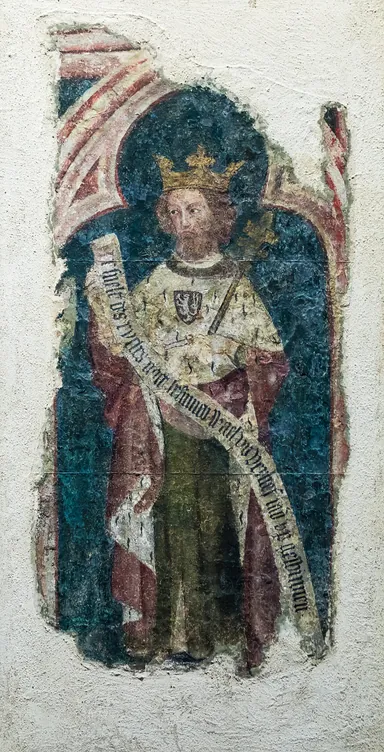 Charles IV of LuxembourgEmperor1316 – 1378Elizabeth of Pomerania · ESConsort1347 – 1393
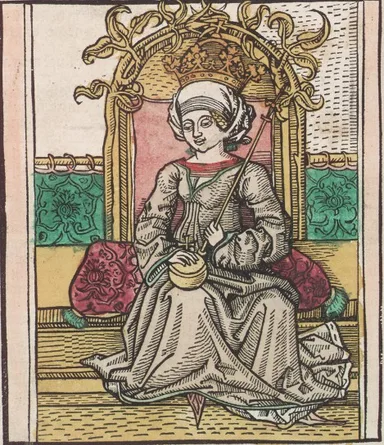 Mary I of HungaryQueen of Hungary and Croatia1371 – 1395Barbara of Cilli · ESConsort1392 – 1451
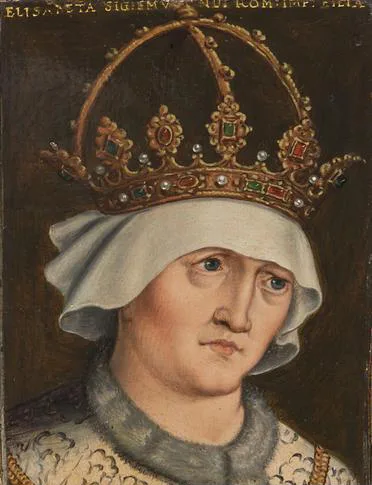 Elizabeth of Luxembourg · ESConsort1409 – 1442
Same dynasty
Wenceslaus IV of LuxembourgKing1361 – 1419Joanna of Luxembourg · ESNoblec. 1370 – 1407Elizabeth of Görlitz · ESDuchess / Consort1390 – 1451Jobst of Moravia · ESKing / Margrave1354 – 1411Catherine of Bohemia · ESConsort1342 – 1395Wenceslaus I of Luxembourg · ESDuke1337 – 1383In their lifetime
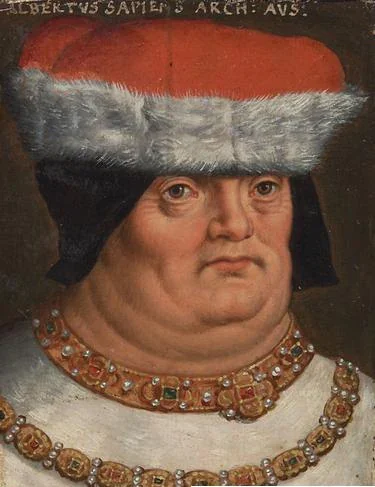 Albert II of GermanyKing / Duke1397 – 1439Wenceslaus IV of LuxembourgKing1361 – 1419George of Poděbrady · ESKing1420 – 1471
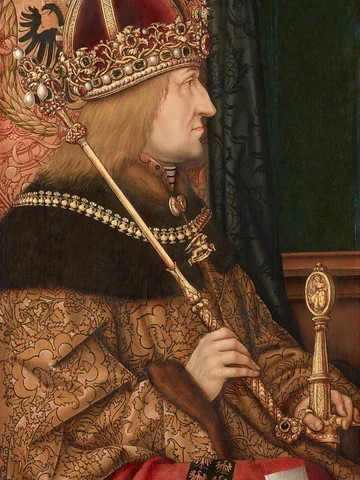 Frederick III of the Holy Roman Empire“the Peaceful”Emperor1415 – 1493
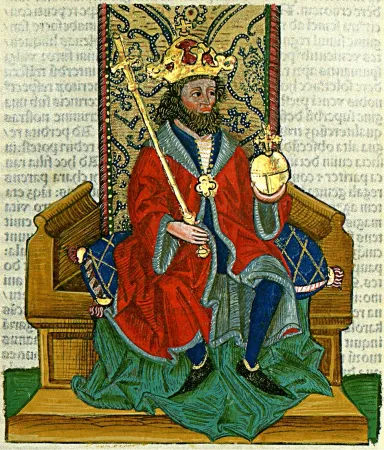 Charles of Durazzo“the Short”Charles III of Naples and Charles II of Hungary1345 – 1386
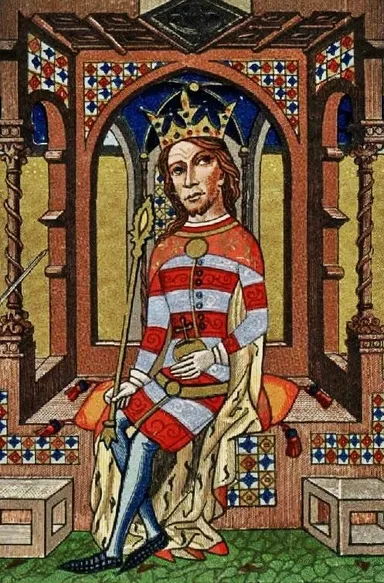 Louis I of Hungary“the Great”King of Hungary, Croatia and Poland1326 – 1382