Charles IV of Luxembourg
An emperor of the House of Luxembourg and King of Bohemia, he made Prague one of Europe’s leading political and cultural centres. The Golden Bull of 1356 established a lasting framework for imperial elections.
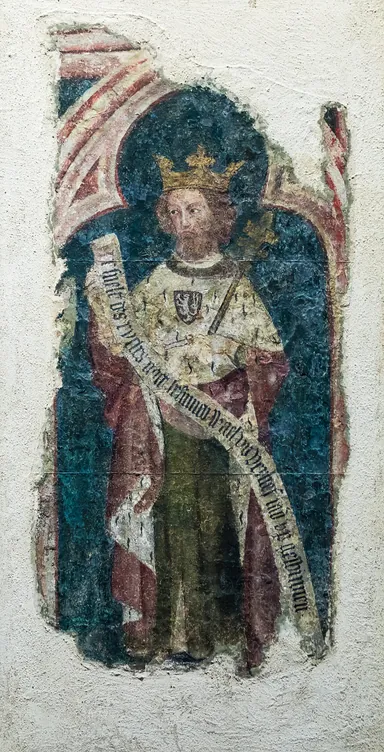
Life of Charles IV of Luxembourg
Education in Paris
The son of John the Blind of Luxembourg and Elizabeth of Bohemia, he was born in Prague in 1316 as Wenceslaus. He was educated at the French court, where he took the name Charles after his godfather, Charles IV, and was taught by the future Pope Clement VI. From 1333 he governed Bohemia on his father’s behalf.
References: Deutsche Biographie · Encyclopaedia Britannica
King and emperor
Elected King of the Romans in 1346 against Louis of Bavaria, he became King of Bohemia that year after his father’s death at Crécy. He prevailed after Louis died in 1347 and was crowned emperor in Rome in 1355. The Golden Bull of 1356 established election by seven prince-electors, a rule that lasted until 1806.
References: Deutsche Biographie · Encyclopaedia Britannica
Prague as a capital
In Prague he founded Central Europe’s first university in 1348, the New Town and the bridge bearing his name, as well as Karlštejn Castle; he also secured the elevation of the bishopric to an archbishopric. Through purchases, inheritances and agreements, he added Lusatia, Silesia and, temporarily, Brandenburg to the Bohemian Crown.
References: Deutsche Biographie · Encyclopaedia Britannica
Preparing the succession
He married four times and secured his son Wenceslaus’s election as King of the Romans during his lifetime in 1376. He died in Prague in 1378, at the beginning of the Western Schism. His sons Wenceslaus and Sigismund inherited Bohemia and imperial authority; Sigismund also became King of Hungary and emperor.
References: Deutsche Biographie · Encyclopaedia Britannica
This complete profile is available in English. Bibliographic titles retain their original language. Links marked ES open the Spanish edition.
Key details
Birth: 14 May 1316 Documented
Death: 29 November 1378 Documented
Role: Emperor
Dynasty: Luxembourg · ES
Territories: Bohemia (ES) · Holy Roman Empire (ES) · Germany (ES) · Silesia (ES) · Moravia (ES)
Recorded relationships
Their titles over time
Follow the changing territories and offices of Charles IV of Luxembourg. Each title retains its own status.
Governments in 1348
- Crown of Saint Wenceslaus3 titles and offices
View titles and jurisdictions
- Bohemia · ESKing · Effective rule1346–1378
- Silesia · ESSovereign · Effective rule · Overlordship of the Bohemian crown over the Silesian duchies; not direct ducal possession1346–1378 · The enfeoffed princes and the bishop of Nysa retain their own governments. The area represents superior sovereignty; Schweidnitz-Jauer was incorporated in 1392. Greater Poland, Lusatia and Glatz are excluded. This does not derive from the imperial office.
- Moravia · ESMargrave · Effective rule1334–1348 · Moravian title from early 1334; John Henry received the margraviate in 1349.
The Lands of the Bohemian Crown (Corona regni Bohemiae), constituted by Charles IV in 1348 and placed under Saint Wenceslaus’s patronage: the Kingdom of Bohemia, the Margraviate of Moravia and the Silesian duchies effectively governed by this person. Provincial titles are retained; Prussian Silesia is not assigned to a Habsburg monarch. Source for this grouping
- Holy Roman Empire (Germany)King of the Romans
View titles and jurisdictions
- Germany · ESKing of the Romans · Effective rule1348–1378
Annual dates: overlap within one year does not prove that two offices were held on the same day. Regencies and co-rulerships retain their labels.
Sources for this profile
- Deutsche Nationalbibliothek · GND authority record · Karl IV., Heiliges Römisches Reich, Kaiser
- Encyclopaedia Britannica
Biographical and contextual references in their original language. Sources and methodology.
Evidence for this profile
14 recorded claims · 5 without a claim-specific source. Context references do not by themselves verify every fact.
Dates (2/2 with a precise source)
- BirthDocumented
14 May 1316
The authority record gives the birth as 1316-05-14. - DeathDocumented
29 November 1378
The authority record gives the death as 1378-11-29.
Family and relationships (5/6 with a precise source)
- FatherDocumented
John of Bohemia
The authority record identifies John of Bohemia (GND 11944755X) as father. - MotherDocumented
Elizabeth of Bohemia
The authority record identifies Elizabeth of Bohemia (GND 120914026) as mother. - Marriage or partnershipDocumented
Blanche of Valois
The authority record identifies Blanche of Valois (GND 136817475) as spouse. - Marriage or partnershipPending review
Anna of Bavaria
A precise source has not yet been added. - Marriage or partnershipDocumented
Anna of Świdnica
The authority record identifies Anna of Świdnica (GND 136828868) as spouse. - Marriage or partnershipDocumented
Elizabeth of Pomerania
The authority record identifies Elizabeth of Pomerania (GND 189559918) as spouse.
Governments (2/6 with a precise source)
- GovernmentPending review
King · Bohemia · 1346–1378
A precise source has not yet been added. - GovernmentPending review
King of the Romans · Germany · 1346–1347
A precise source has not yet been added. - GovernmentPending review
King of the Romans · Germany · 1348–1378
A precise source has not yet been added. - GovernmentPending review
Emperor · Holy Roman Empire · 1355–1378
A precise source has not yet been added. - GovernmentInferred
Sovereign · Silesia · 1346–1378
The enfeoffed princes and the bishop of Nysa retain their own governments. The area represents superior sovereignty; Schweidnitz-Jauer was incorporated in 1392. Greater Poland, Lusatia and Glatz are excluded. This does not derive from the imperial office.City of Wrocław · history · The Duchy of Wrocław (Breslau) was incorporated into the Crown of Bohemia in 1335 after the death of Henry VI; Habsburg from 1526; Prussian conquest in 1741.Powiat Średzki · historia institucional · Środa Śląska within the royal Duchy of Wrocław after 1335; Habsburg period from 1526 and Prussian takeover in 1742.Homann · Ducatus Silesiae, 1716 · David Rumsey Collection · Regional map of Upper and Lower Silesia and its duchies. Crown sovereignty is distinguished from each prince’s local government.German Historical Institute · Growth of the Habsburg Empire, 1282–1918 · Map of acquisitions: Austria and Styria in 1282, Carinthia in 1335, Tyrol in 1363, Bohemia and Silesia in 1526, Hungary in 1699 and the Banat in 1718. Imperial office did not confer dominion over all imperial states. - GovernmentDocumented
Margrave · Moravia · 1334–1348
Moravian title from early 1334; John Henry received the margraviate in 1349.
Biographical and contextual references (2)
Editorial history
- 2026-10-12 · Claim registry added; existing historical data kept. Specific sourcing remains to be reviewed.
- 2026-10-08 · Claim registry added; existing historical data kept. Specific sourcing remains to be reviewed.
- 2026-10-04 · Claim registry added; existing historical data kept. Specific sourcing remains to be reviewed.
- 2026-10-04 · Claim registry added; existing historical data kept. Specific sourcing remains to be reviewed.
- 2026-10-03 · Claim registry added; existing historical data kept. Specific sourcing remains to be reviewed.
- 2026-09-30 · The duchy is limited to Dijon and Autun; each other fief now enters the map only under its dated ruler. John III of Namur and the Nevers/Rethel branch were added. The previous shape combined later counties and unrelated lands as if all belonged to the duchy from 1363.
- 2026-09-28 · Claim registry added; existing historical data kept. Specific sourcing remains to be reviewed.
Follow this person through history
More paths from Charles IV of Luxembourg
Family
 John of Bohemia · ESKing1296 – 1346Elizabeth of Bohemia · ESConsort1292 – 1330Blanche of Valois · ESConsort1316 – 1348Anna of Bavaria · ESConsort1329 – 1353Anna of Świdnica · ESConsort1339 – 1362Elizabeth of Pomerania · ESConsort1347 – 1393