
Charles III of Spain
He ruled Naples and Sicily from 1734 before inheriting the Spanish monarchy in 1759. He then ceded both Italian kingdoms to his son Ferdinand. His Spanish reign promoted urban and administrative reforms.
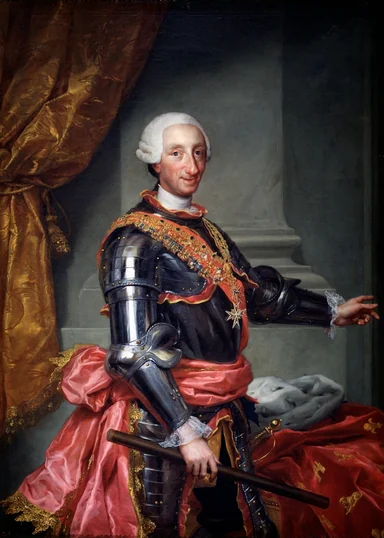
Life of Charles III of Spain
Duke of Parma and King of Naples
The son of Philip V and Elisabeth Farnese, he was born in Madrid in 1716. He was Duke of Parma from 1731 and conquered Naples in 1734; from 1735 he was King of Naples and Sicily. There he promoted projects such as the Palace of Caserta and the excavations at Herculaneum and Pompeii.
References: Real Academia de la Historia · Diccionario Biográfico español · Treccani · Dizionario Biografico degli Italiani · Deutsche Biographie · Encyclopaedia Britannica
King of Spain
In 1759 he inherited Spain from his half-brother Ferdinand VI and left Naples to his son Ferdinand. With ministers such as Esquilache, Aranda, Campomanes and Floridablanca, he implemented Enlightenment reforms in finance, trade with the Americas and administration. The Esquilache Riots in 1766 and the expulsion of the Jesuits in 1767 marked his reign.
References: Real Academia de la Historia · Diccionario Biográfico español · Treccani · Dizionario Biografico degli Italiani · Deutsche Biographie · Encyclopaedia Britannica
Foreign policy and legacy
The Family Compacts with the French Bourbons brought him into the Seven Years’ War and into supporting the independence of the United States, through which he recovered Minorca and Florida in 1783. In Madrid he promoted projects such as the Puerta de Alcalá and the Paseo del Prado. He died in 1788.
References: Real Academia de la Historia · Diccionario Biográfico español · Treccani · Dizionario Biografico degli Italiani · Deutsche Biographie · Encyclopaedia Britannica
This complete profile is available in English. Bibliographic titles retain their original language. Links marked ES open the Spanish edition.
Key details
Birth: 20 January 1716 Documented
Death: 14 December 1788 Documented
Role: King of Spain
Dynasty: Bourbon · ES
Territories: Spain (ES) · Navarre (ES) · Naples (ES) · Trinacria (ES) · Castile (ES) · León (ES) · Aragon (ES) · County of Barcelona (ES) · Valencia (ES) · Majorca (ES)
Recorded relationships
Their titles over time
Follow the changing territories and offices of Charles III of Spain. Each title retains its own status.
Governments in 1759
- Spain7 titles and offices
View titles and jurisdictions
- Castile · ESKing · Effective rule1759–1788
- León · ESKing · Effective rule1759–1788
- Aragon · ESKing · Effective rule1759–1788
- Navarre · ESKing · Branch rule · Upper Navarre after the conquest1759–1788 · From 1512 the two lines did not effectively govern the whole of the former kingdom.
- County of Barcelona · ESCount · Effective rule1759–1788
- Valencia · ESKing · Effective rule1759–1788
- Majorca · ESKing · Effective rule1759–1788
The monarchy’s crowns and dominions. Portugal retained a separate administration during the dynastic union of 1580–1640. Source for this grouping
- Monarchy of Naples and Sicily2 titles and offices
View titles and jurisdictions
- Naples · ESKing · Effective rule1734–1759 · Conquest in 1734; the Sicilian coronation took place in 1735. He ceded both kingdoms to his son Ferdinand on acceding to the Spanish throne in 1759.
- Trinacria · ESKing · Effective rule1734–1759 · Conquest in 1734; the Sicilian coronation took place in 1735. He ceded both kingdoms to his son Ferdinand on acceding to the Spanish throne in 1759.
Crowns united under Charles of Bourbon and his son Ferdinand. The two kingdoms retained their identities; the Kingdom of the Two Sicilies, created in 1816, is not projected backwards. The Neapolitan Republic of 1799 retains its own territorial attribution. Source for this grouping
Annual dates: overlap within one year does not prove that two offices were held on the same day. Regencies and co-rulerships retain their labels.
How these titles came together
- 1734 · NaplesConquest
Charles of Bourbon took the mainland kingdom in 1734. On inheriting Spain in 1759 he transferred Naples to his son Ferdinand.
- 1734 · TrinacriaConquest
Sicily was conquered in 1734 and the coronation in Palermo took place in 1735. It was not a Neapolitan province.
Selected explained accessions. Other titles remain in the profile’s list of recorded governments.
Sources for this profile
- Treccani · Carlos de Borbón, rey de Nápoles y Sicilia
- Treccani · Nápoles y las sucesiones de 1707, 1734 y 1759
- Deutsche Nationalbibliothek · GND authority record · Karl III., Spanien, König
- Real Academia de la Historia · Diccionario Biográfico español
- Treccani · Dizionario Biografico degli Italiani
- Encyclopaedia Britannica
Biographical and contextual references in their original language. Sources and methodology.
Evidence for this profile
16 recorded claims · 7 without a claim-specific source. Context references do not by themselves verify every fact.
Dates (2/2 with a precise source)
- BirthDocumented
20 January 1716
The authority record gives the birth as 1716-01-20. - DeathDocumented
14 December 1788
The authority record gives the death as 1788-12-14.
Family and relationships (3/3 with a precise source)
- FatherDocumented
Philip V of Spain
The authority record identifies Philip V of Spain (GND 119186640) as father. - MotherDocumented
Elisabeth Farnese
The authority record identifies Elisabeth Farnese (GND 119151804) as mother. - Marriage or partnershipDocumented
Maria Amalia of Saxony
The authority record identifies Maria Amalia of Saxony (GND 137353766) as spouse.
Governments (2/9 with a precise source)
- GovernmentPending review
King · Castile · 1759–1788
A precise source has not yet been added. - GovernmentPending review
King · León · 1759–1788
A precise source has not yet been added. - GovernmentPending review
King · Aragon · 1759–1788
A precise source has not yet been added. - GovernmentPending review
Count · County of Barcelona · 1759–1788
A precise source has not yet been added. - GovernmentPending review
King · Valencia · 1759–1788
A precise source has not yet been added. - GovernmentPending review
King · Majorca · 1759–1788
A precise source has not yet been added. - GovernmentDocumented
King · Naples · 1734–1759
He conquered the kingdom in 1734 and ceded it to his son Ferdinand in 1759. - GovernmentDocumented
King · Trinacria · 1734–1759
The Sicilian conquest took place in 1734; the formal coronation was held in 1735.
Successions (2/2 with a precise source)
- SuccessionDocumented
Naples · Unrecorded successor · 1734
Charles of Bourbon took the mainland kingdom in 1734. On inheriting Spain in 1759 he transferred Naples to his son Ferdinand. - SuccessionDocumented
Trinacria · Unrecorded successor · 1734
Sicily was conquered in 1734 and the coronation in Palermo took place in 1735. It was not a Neapolitan province.
Biographical and contextual references (6)
- Treccani · Carlos de Borbón, rey de Nápoles y Sicilia
- Treccani · Nápoles y las sucesiones de 1707, 1734 y 1759
- Deutsche Nationalbibliothek · GND authority record · Karl III., Spanien, König
- Real Academia de la Historia · Diccionario Biográfico español
- Treccani · Dizionario Biografico degli Italiani
- Encyclopaedia Britannica
Editorial history
- 2026-10-12 · Claim registry added; existing historical data kept. Specific sourcing remains to be reviewed.
- 2026-10-08 · Claim registry added; existing historical data kept. Specific sourcing remains to be reviewed.
- 2026-10-04 · Claim registry added; existing historical data kept. Specific sourcing remains to be reviewed.
- 2026-10-04 · Claim registry added; existing historical data kept. Specific sourcing remains to be reviewed.
- 2026-10-03 · Claim registry added; existing historical data kept. Specific sourcing remains to be reviewed.
- 2026-09-30 · The duchy is limited to Dijon and Autun; each other fief now enters the map only under its dated ruler. John III of Namur and the Nevers/Rethel branch were added. The previous shape combined later counties and unrelated lands as if all belonged to the duchy from 1363.
- 2026-09-28 · Claim registry added; existing historical data kept. Specific sourcing remains to be reviewed.
More paths from Charles III of Spain
Family
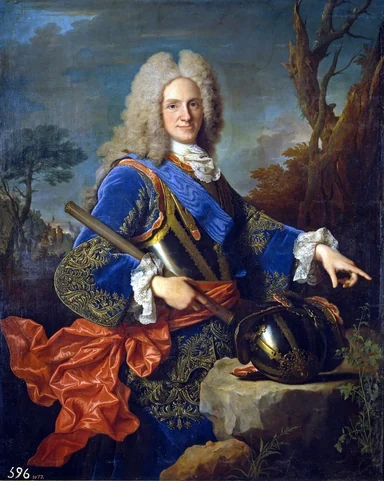 Philip V of Spain“the Spirited”King of Spain1683 – 1746Elisabeth Farnese · ESConsort1692 – 1766Maria Amalia of Saxony · ESConsort1724 – 1760Ferdinand IV of Naples · ESKing1751 – 1825
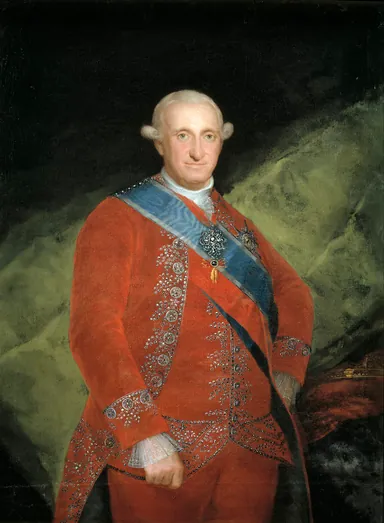 Charles IV of SpainKing of Spain1748 – 1819Maria Luisa of Spain · ESConsort1745 – 1792
Same dynasty
Mariana Victoria of Spain · ESConsort1718 – 1781Louis, Dauphin of France · ESPrince / Dauphin1729 – 1765Maria Antonia Ferdinanda of Spain · ESConsort1729 – 1785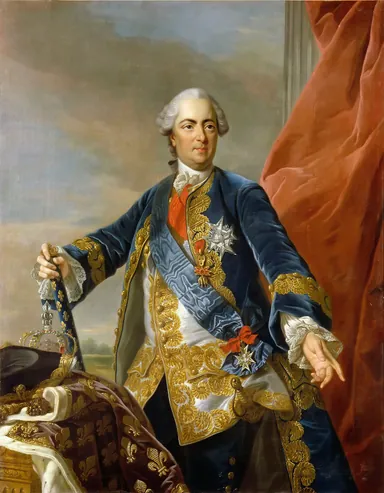 Louis XV of France“the Beloved”King of France · Titular king of Navarre1710 – 1774
 Ferdinand VI of Spain“the Learned”King of Spain1713 – 1759Maria Teresa Rafaela of Spain · ESConsort / Dauphine1726 – 1746
In their lifetime
Ferdinand VI of Spain“the Learned”King of Spain1713 – 1759 Louis I of Spain“the Beloved”King of Spain1707 – 1724
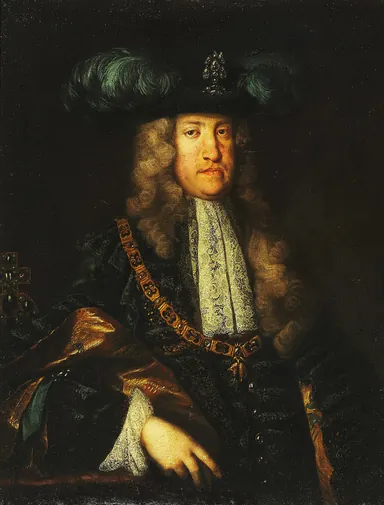 Charles VI, Holy Roman Emperor · ESEmperor1685 – 1740Louis XV of France“the Beloved”King of France · Titular king of Navarre1710 – 1774
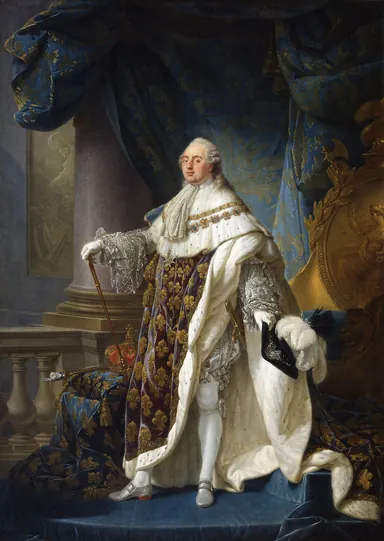 Louis XVI of FranceKing of France · Titular king of Navarre1754 – 1793Louis, Dauphin of France · ESPrince / Dauphin1729 – 1765