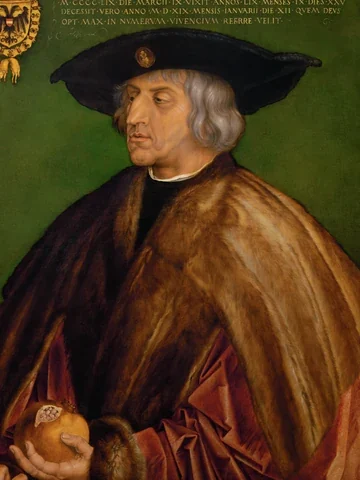
Charles I of Burgundy
The last great Valois duke of Burgundy. He died outside Nancy in 1477; the French Crown incorporated the duchy, while his daughter Mary inherited rights over the Low Countries and Franche-Comté. The inheritance was disputed and did not remain a united state.
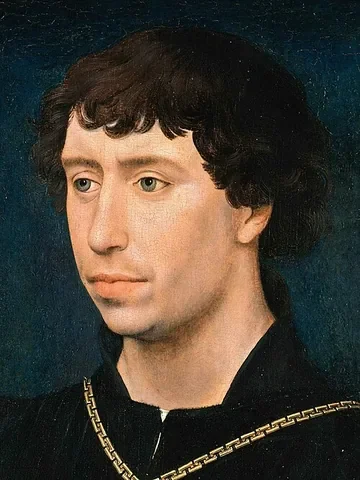
Life of Charles I of Burgundy
Philip the Good’s heir
The son of Philip III of Burgundy and Isabella of Portugal, he was born in Dijon in 1433. As Count of Charolais, he opposed Louis XI in the League of the Public Weal (1465) and succeeded his father in 1467.
References: Deutsche Biographie · Encyclopaedia Britannica
The dream of a crown
He wanted to unite his Burgundian and Netherlandish domains in a kingdom between France and the Empire. He negotiated with Emperor Frederick III at Trier (1473) without obtaining a crown. He occupied Lorraine and Guelders, but his campaigns against the Swiss ended in defeats at Grandson and Murten (1476).
References: Deutsche Biographie · Encyclopaedia Britannica
Nancy and the inheritance
He died at the Battle of Nancy in January 1477. Louis XI occupied the Duchy of Burgundy, while his daughter Mary retained the Low Countries and married Maximilian of Habsburg. This began the Habsburg presence in the Low Countries.
References: Deutsche Biographie · Encyclopaedia Britannica
This complete profile is available in English. Bibliographic titles retain their original language. Links marked ES open the Spanish edition.
Key details
Birth: 10 November 1433 Documented
Death: 5 January 1477 Documented
Role: Duke
Dynasty: Valois-Burgundy
Territories: Burgundy (ES) · Flanders (ES) · Brabant (ES) · Limburg (ES) · Holland (ES) · Hainaut (ES) · Zeeland (ES) · Guelders (ES) · Namur (ES) · Luxembourg (ES) · Artois (ES) · County of Burgundy (ES) · Auxerre (ES) · Ponthieu (ES)
Recorded relationships
Their titles over time
Follow the changing territories and offices of Charles I of Burgundy. Each title retains its own status.
Governments in 1473
- Burgundian State14 titles and offices
View titles and jurisdictions
- Burgundy · ESDuke · Effective rule1467–1477
- Flanders · ESCount · Effective rule1467–1477
- Brabant · ESDuke · Effective rule1467–1477
- Limburg · ESDuke · Effective rule1467–1477
- Holland · ESCount · Effective rule1467–1477
- Hainaut · ESCount · Effective rule1467–1477
- Zeeland · ESCount · Effective rule1467–1477
- Guelders · ESDuke · Effective rule1473–1477
- Namur · ESCount · Effective rule1467–1477 · Burgundian inheritance arising from Philip the Good’s acquisition of the county.
- Luxembourg · ESDuke · Effective rule1467–1477 · Duchy incorporated into the Burgundian patrimony by Philip the Good in 1443.
- Artois · ESCount · Effective rule1467–1477
- County of Burgundy · ESCount · Effective rule1467–1477
- Auxerre · ESCount · Effective rule1467–1477 · French county distinct from the Burgundian duchy.
- Ponthieu · ESCount · Effective rule1467–1477 · The cession of 1435 reverted to the French Crown after the duke’s death.
Fiefs brought together under the Valois dukes of Burgundy from 1384 and their heirs. Before sharing a duke, each county keeps its colour; the grouping excludes other kingdoms held by the same sovereign. Source for this grouping
Annual dates: overlap within one year does not prove that two offices were held on the same day. Regencies and co-rulerships retain their labels.
How these titles came together
- 1467 · Flanders · Brabant · Holland · Hainaut · ZeelandInheritance
Charles the Bold inherited from Philip the Good. A shared heir did not turn the separate counties and duchies into a single title.
- 1473 · GueldersAgreement · Conquest
Charles the Bold invoked Arnold’s cession of rights and occupied the duchy militarily. The agreement alone did not guarantee territorial control or extinguish the Egmond claim.
Selected explained accessions. Other titles remain in the profile’s list of recorded governments.
Sources for this profile
- Metropolitan Museum · Formation of the Burgundian Netherlands
- Biblissima/BnF · Títulos de Felipe el Bueno
- Cambridge University Press · Ponthieu y las ciudades del Somme
- BnF Gallica · El condado de Auxerre cedido en 1435
- Luxembourg · The duchy in the Burgundian inheritance
- Citadelle de Namur · The County of Namur and Philip the Good
- Archives de la Côte-d’Or · The court of Philip the Good
- Académie de Dijon · Philippe le Hardi, duc apanagiste et lieutenant du roi (1363)
- Annales de Bourgogne · Charles VII et ses conseillers, assassins présumés de Jean sans Peur (1942), pp. 197–210
- Meinrad Lienert · Schweizer Sagen und Heldengeschichten (1915), Die Beute von Grandson; recogido por la Mutabor Märchenstiftung
- A. G. Jongkees · Charles le Téméraire et la souveraineté, BMGN 95 (1980), pp. 314–334
- Ruth Putnam · Charles the Bold, the Last Duke of Burgundy (1908), capítulos XIV y XXI; testimonios del ceremonial y del hallazgo del cuerpo
- Diccionario histórico de Suiza · Charles le Téméraire
- Museo Nacional Suizo · La bataille de Grandson
- Die Welt der Habsburger · Maximilian and the Burgundian inheritance
- Die Welt der Habsburger · Marrying into Burgundy
- Metropolitan Museum of Art · Burgundian Netherlands: Court Life and Patronage
- Deutsche Nationalbibliothek · GND authority record · Karl, Burgund, Herzog
- Encyclopaedia Britannica
Biographical and contextual references in their original language. Sources and methodology.
Evidence for this profile
27 recorded claims · 0 without a claim-specific source. Context references do not by themselves verify every fact.
Dates (2/2 with a precise source)
- BirthDocumented
10 November 1433
The authority record gives the birth as 1433-11-10. - DeathDocumented
5 January 1477
The authority record gives the death as 1477-01-05.
Family and relationships (5/5 with a precise source)
- FatherDocumented
Philip III of Burgundy
Paternal relationship confirmed by the source. - MotherDocumented
Isabella of Portugal
Maternal relationship confirmed by the source. - Marriage or partnershipDocumented
Catherine of Valois
Marriage confirmed by the source. - Marriage or partnershipDocumented
Isabella of Bourbon
The authority record identifies Isabella of Bourbon (GND 13285662X) as spouse. - Marriage or partnershipDocumented
Margaret of York
The authority record identifies Margaret of York (GND 118886452) as spouse.
Governments (14/14 with a precise source)
- GovernmentDocumented
Duke · Burgundy · 1467–1477
Duke of Burgundy, 1467–1477, checked against the source. - GovernmentDocumented
Count · Flanders · 1467–1477
Count of Flanders, 1467–1477, checked against the source. - GovernmentDocumented
Duke · Brabant · 1467–1477
Duke of Brabant, 1467–1477, checked against the source. - GovernmentDocumented
Duke · Limburg · 1467–1477
Duke of Limburg, 1467–1477, checked against the source. - GovernmentDocumented
Count · Holland · 1467–1477
Count of Holland, 1467–1477, checked against the source. - GovernmentDocumented
Count · Hainaut · 1467–1477
Count of Hainaut, 1467–1477, checked against the source. - GovernmentDocumented
Count · Zeeland · 1467–1477
Count of Zeeland, 1467–1477, checked against the source. - GovernmentDocumented
Duke · Guelders · 1473–1477
Duke of Guelders, 1473–1477, checked against the source. - GovernmentDocumented
Count · Namur · 1467–1477
Burgundian inheritance arising from Philip the Good’s acquisition of the county. - GovernmentDocumented
Duke · Luxembourg · 1467–1477
Duchy incorporated into the Burgundian patrimony by Philip the Good in 1443. - GovernmentDocumented
Count · Artois · 1467–1477
Count of Artois, 1467–1477, checked against the source. - GovernmentDocumented
Count · County of Burgundy · 1467–1477
Count of the County of Burgundy, 1467–1477, checked against the source. - GovernmentDocumented
Count · Auxerre · 1467–1477
French county distinct from the Burgundian duchy. - GovernmentDocumented
Count · Ponthieu · 1467–1477
The cession of 1435 reverted to the French Crown after the duke’s death.
Successions (6/6 with a precise source)
- SuccessionDocumented
Guelders · Arnold of Egmond → Charles I of Burgundy · 1473
Succession checked against the source. - SuccessionDocumented
Flanders · Philip III of Burgundy → Charles I of Burgundy · 1467
Succession checked against the source. - SuccessionDocumented
Brabant · Philip III of Burgundy → Charles I of Burgundy · 1467
Succession checked against the source. - SuccessionDocumented
Holland · Philip III of Burgundy → Charles I of Burgundy · 1467
Succession checked against the source. - SuccessionDocumented
Hainaut · Philip III of Burgundy → Charles I of Burgundy · 1467
Succession checked against the source. - SuccessionDocumented
Zeeland · Philip III of Burgundy → Charles I of Burgundy · 1467
Succession checked against the source.
Biographical and contextual references (19)
- Metropolitan Museum · Formation of the Burgundian Netherlands
- Biblissima/BnF · Títulos de Felipe el Bueno
- Cambridge University Press · Ponthieu y las ciudades del Somme
- BnF Gallica · El condado de Auxerre cedido en 1435
- Luxembourg · The duchy in the Burgundian inheritance
- Citadelle de Namur · The County of Namur and Philip the Good
- Archives de la Côte-d’Or · The court of Philip the Good
- Académie de Dijon · Philippe le Hardi, duc apanagiste et lieutenant du roi (1363)
- Annales de Bourgogne · Charles VII et ses conseillers, assassins présumés de Jean sans Peur (1942), pp. 197–210
- Meinrad Lienert · Schweizer Sagen und Heldengeschichten (1915), Die Beute von Grandson; recogido por la Mutabor Märchenstiftung
- A. G. Jongkees · Charles le Téméraire et la souveraineté, BMGN 95 (1980), pp. 314–334
- Ruth Putnam · Charles the Bold, the Last Duke of Burgundy (1908), capítulos XIV y XXI; testimonios del ceremonial y del hallazgo del cuerpo
- Diccionario histórico de Suiza · Charles le Téméraire
- Museo Nacional Suizo · La bataille de Grandson
- Die Welt der Habsburger · Maximilian and the Burgundian inheritance
- Die Welt der Habsburger · Marrying into Burgundy
- Metropolitan Museum of Art · Burgundian Netherlands: Court Life and Patronage
- Deutsche Nationalbibliothek · GND authority record · Karl, Burgund, Herzog
- Encyclopaedia Britannica
Editorial history
- 2026-10-12 · Claim registry added; existing historical data kept. Specific sourcing remains to be reviewed.
- 2026-10-08 · Claim registry added; existing historical data kept. Specific sourcing remains to be reviewed.
- 2026-10-04 · Claim registry added; existing historical data kept. Specific sourcing remains to be reviewed.
- 2026-10-04 · Claim registry added; existing historical data kept. Specific sourcing remains to be reviewed.
- 2026-10-03 · Claim registry added; existing historical data kept. Specific sourcing remains to be reviewed.
- 2026-09-30 · The duchy is limited to Dijon and Autun; each other fief now enters the map only under its dated ruler. John III of Namur and the Nevers/Rethel branch were added. The previous shape combined later counties and unrelated lands as if all belonged to the duchy from 1363.
- 2026-09-28 · Claim registry added; existing historical data kept. Specific sourcing remains to be reviewed.
Follow this person through history
More paths from Charles I of Burgundy
Family
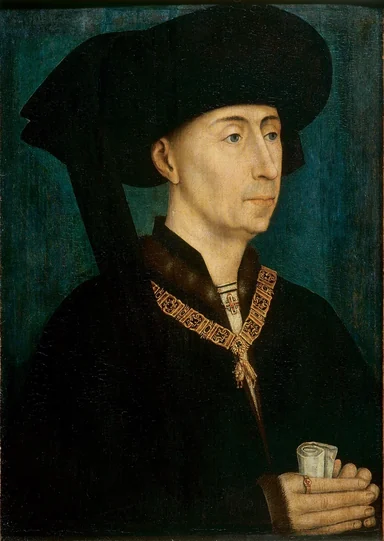 Philip III of Burgundy“the Good”Duke1396 – 1467
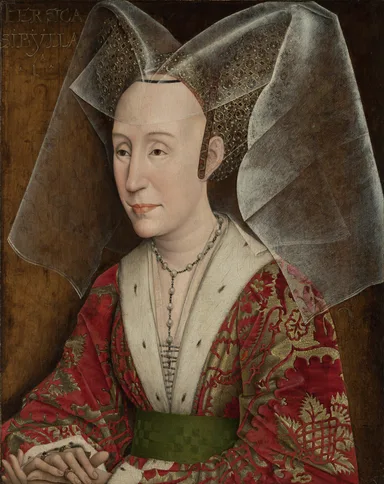 Isabella of PortugalConsort1397 – 1471Catherine of Valois · ESConsort1428 – 1446Isabella of Bourbon · ESConsort1436 – 1465Margaret of York · ESConsort1446 – 1503
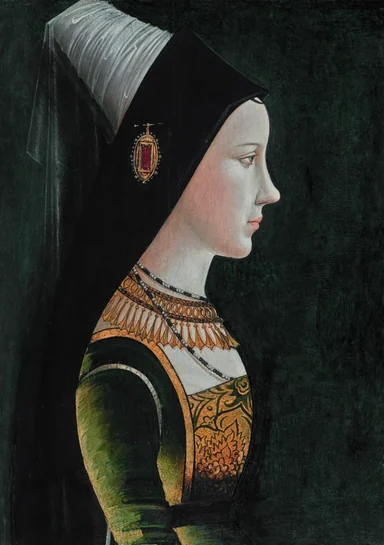 Mary of Burgundy“the Rich”Duchess of Burgundy1457 – 1482