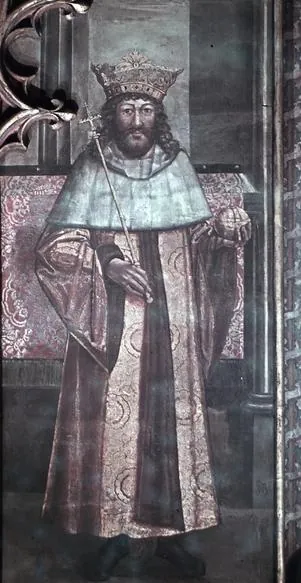
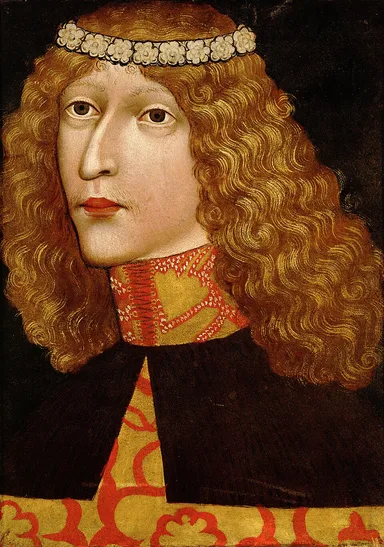
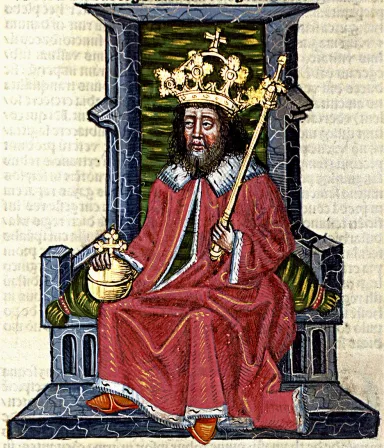
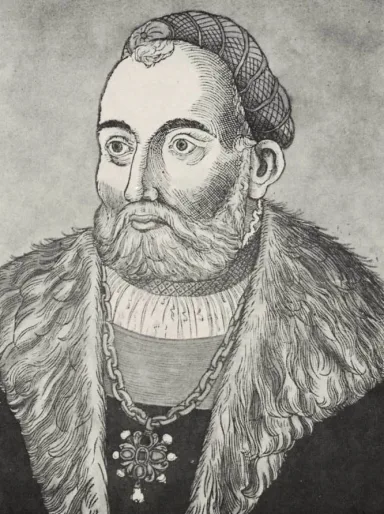
Matthias Corvinus
He strengthened the Hungarian army and administration and contested territories with the Habsburgs and Jagiellonians. His library and court made Buda a centre of Renaissance humanism.
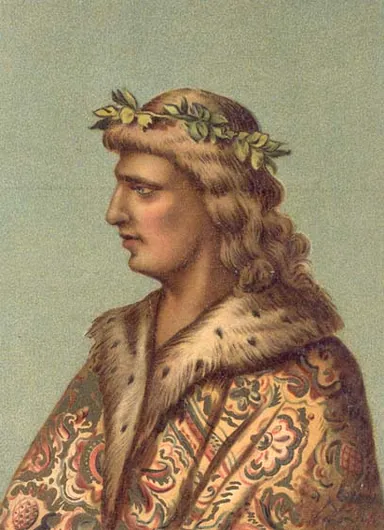
Life of Matthias Corvinus
The son of John Hunyadi
Born at Kolozsvár, now Cluj, in 1443, Matthias was the son of the regent John Hunyadi, who defended Belgrade against the Ottomans. After his father’s death and his brother Ladislaus’s execution, he was imprisoned at Prague. In 1458 the Hungarian nobility elected him king at the age of fifteen. He was not crowned until 1464, after recovering the Holy Crown from Emperor Frederick III.
References: Deutsche Biographie · Encyclopaedia Britannica
Central power
He strengthened royal finances with new taxes and created a standing force of mercenaries, later known as the Black Army. He held the Ottomans at the southern frontier, captured Jajce in Bosnia in 1463 and suppressed several conspiracies by magnates and prelates.
References: Deutsche Biographie · Encyclopaedia Britannica
Conquests in the west
He fought George of Poděbrady and was elected King of Bohemia by the Catholics in 1469, although he controlled only Moravia, Silesia and Lusatia. At war with Frederick III, he occupied Vienna in 1485 and resided there until his death in 1490.
References: Deutsche Biographie · Encyclopaedia Britannica
A Renaissance court
Married to Beatrice of Aragon, daughter of Ferrante of Naples, he attracted Italian humanists, architects and artists to Buda and assembled the Bibliotheca Corviniana, one of the greatest of its time. He had no legitimate children: his illegitimate son John Corvinus failed to secure the succession, which passed to Vladislaus II Jagiellon.
References: Deutsche Biographie · Encyclopaedia Britannica
This complete profile is available in English. Bibliographic titles retain their original language. Links marked ES open the Spanish edition.
Key details
Birth: 23 February 1443 Documented
Death: 6 April 1490 Documented
Role: King of Hungary · Rival king of Bohemia
Other recorded names: Matthias I · Matthias I of Hungary · Matthias Corvinus (Matthias I)
Dynasty: Hunyadi · ES
Territories: Hungary (ES) · Bohemia (ES) · Croatia (ES) · Moravia (ES) · Silesia (ES)
Recorded relationships
Their titles over time
Follow the changing territories and offices of Matthias Corvinus. Each title retains its own status.
Governments in 1469
- Crown of Saint Stephen2 titles and offices
View titles and jurisdictions
- Hungary · ESKing · Effective rule1458–1490
- Croatia · ESKing · Effective rule1458–1490
The kingdoms of the Hungarian crown and, before its eastern separation, the voivodeship of Transylvania. Each title retains its identity; an independent Transylvanian prince or an Ottoman tributary is not included merely because of a shared ruler or proximity. Source for this grouping
- MoraviaMargrave
View titles and jurisdictions
- Moravia · ESMargrave · Effective rule · Royal centres of Brno and Olomouc; regional authority over the margraviate, distinct from the full geography of the Bohemian title1469–1490 · Brno and Olomouc are regional urban centres; they are not equated with the monarch’s exclusive ownership of Moravia and do not erase seigneurial or episcopal jurisdictions. Olomouc begins with the privilege of 1378 and is excluded during the documented Swedish and Prussian occupations.
- SilesiaSovereign
View titles and jurisdictions
- Silesia · ESSovereign · Effective rule · Overlordship of the Bohemian crown over the Silesian duchies; not direct ducal possession1469–1490 · The enfeoffed princes and the bishop of Nysa retain their own governments. The area represents superior sovereignty; Schweidnitz-Jauer was incorporated in 1392. Greater Poland, Lusatia and Glatz are excluded. This does not derive from the imperial office.
Nominal and disputed titles (1)
- Bohemia · ESKing · Rival1469–1490
Annual dates: overlap within one year does not prove that two offices were held on the same day. Regencies and co-rulerships retain their labels.
Sources for this profile
- Deutsche Nationalbibliothek · GND authority record · Matthias I., Ungarn, König
- Encyclopaedia Britannica
Biographical and contextual references in their original language. Sources and methodology.
Evidence for this profile
8 recorded claims · 3 without a claim-specific source. Context references do not by themselves verify every fact.
Dates (2/2 with a precise source)
- BirthDocumented
23 February 1443
The authority record gives the birth as 1443-02-23. - DeathDocumented
6 April 1490
The authority record gives the death as 1490-04-06.
Family and relationships (1/1 with a precise source)
- Marriage or partnershipDocumented
Beatrice of Naples
The authority record identifies Beatrice of Naples (GND 118654187) as spouse.
Governments (2/5 with a precise source)
- GovernmentPending review
King · Hungary · 1458–1490
A precise source has not yet been added. - GovernmentPending review
King · Bohemia · 1469–1490
A precise source has not yet been added. - GovernmentPending review
King · Croatia · 1458–1490
A precise source has not yet been added. - GovernmentInferred
Margrave · Moravia · 1469–1490
Brno and Olomouc are regional urban centres; they are not equated with the monarch’s exclusive ownership of Moravia and do not erase seigneurial or episcopal jurisdictions. Olomouc begins with the privilege of 1378 and is excluded during the documented Swedish and Prussian occupations.Brno City Archives · Brno v minulosti a dnes 4 · Taxation of Moravian royal towns: Brno, Znojmo, Jihlava and Olomouc; interregnum, 1439–1453; Ladislaus took over government at Brno in summer 1453; Matthias exercised authority from the war of 1468–1469; reunification under Vladislaus in 1490.City of Olomouc · history of the city · Jobst’s privilege in 1378; loyalty to Sigismund; election of Corvinus in 1469 and agreement of 1479; Frederick of the Palatinate in 1620; Swedish occupation, 1642–1650, and Prussian occupation, 1741–1742; royal confirmation by Maria Theresa in 1762.Olomouc Municipal Archives · original charter of Jobst · Olomouc District Archive, City Archive collection, Charters, inventory 37: Margrave Jobst’s permission of 1378 to build a town hall and merchants’ hall. - GovernmentInferred
Sovereign · Silesia · 1469–1490
The enfeoffed princes and the bishop of Nysa retain their own governments. The area represents superior sovereignty; Schweidnitz-Jauer was incorporated in 1392. Greater Poland, Lusatia and Glatz are excluded. This does not derive from the imperial office.Archiwa Państwowe · original royal charter of 1469 · In 1469 Matthias Corvinus confirmed the privileges of Wrocław and Środa Śląska granted by John and Wenceslaus. Effective regional authority despite his rival title in Bohemia.Homann · Ducatus Silesiae, 1716 · David Rumsey Collection · Regional map of Upper and Lower Silesia and its duchies. Crown sovereignty is distinguished from each prince’s local government.German Historical Institute · Growth of the Habsburg Empire, 1282–1918 · Map of acquisitions: Austria and Styria in 1282, Carinthia in 1335, Tyrol in 1363, Bohemia and Silesia in 1526, Hungary in 1699 and the Banat in 1718. Imperial office did not confer dominion over all imperial states.
Biographical and contextual references (2)
Editorial history
- 2026-10-12 · Claim registry added; existing historical data kept. Specific sourcing remains to be reviewed.
- 2026-10-08 · Claim registry added; existing historical data kept. Specific sourcing remains to be reviewed.
- 2026-10-04 · Claim registry added; existing historical data kept. Specific sourcing remains to be reviewed.
- 2026-10-04 · Claim registry added; existing historical data kept. Specific sourcing remains to be reviewed.
- 2026-10-03 · Claim registry added; existing historical data kept. Specific sourcing remains to be reviewed.
- 2026-09-30 · The duchy is limited to Dijon and Autun; each other fief now enters the map only under its dated ruler. John III of Namur and the Nevers/Rethel branch were added. The previous shape combined later counties and unrelated lands as if all belonged to the duchy from 1363.
- 2026-09-28 · Claim registry added; existing historical data kept. Specific sourcing remains to be reviewed.