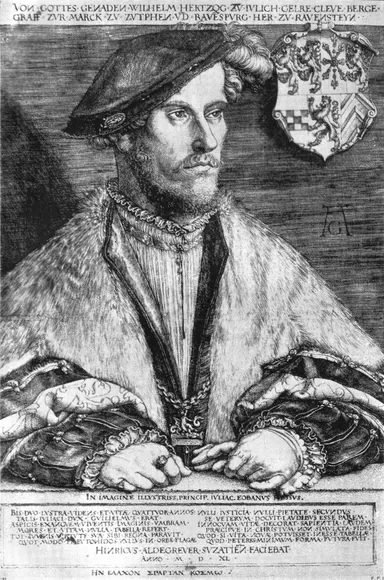
John Sigismund of Brandenburg
Elector of Brandenburg from 1608. He adopted Calvinism in 1613 and inherited the Duchy of Prussia in 1618, joining it to Brandenburg under the Hohenzollerns.
This complete profile is available in English. Bibliographic titles retain their original language. Links marked ES open the Spanish edition.
Key details
Birth: 8 November 1572 Documented
Death: 23 December 1619 Documented
Role: Elector / Duke
Dynasty: Hohenzollern · ES
Territories: Brandenburg (ES) · Prussia (ES) · Cleves (ES) · Mark (ES) · Ravensberg (ES)
Recorded relationships
Their titles over time
Follow the changing territories and offices of John Sigismund of Brandenburg. Each title retains its own status.
Governments in 1618
- Brandenburg-Prussia5 titles and offices
View titles and jurisdictions
- Brandenburg · ESElector · Effective rule1608–1619
- Prussia · ESDuke · Effective rule1618–1619
- Cleves · ESDuke · Effective rule1614–1619 · Possession from the provisional Treaty of Xanten (1614); definitive hereditary partition in 1666.
- Mark · ESCount · Effective rule1614–1619 · Possession from the provisional Treaty of Xanten (1614); definitive hereditary partition in 1666.
- Ravensberg · ESCount · Effective rule1614–1619 · Possession from the provisional Treaty of Xanten (1614); definitive hereditary partition in 1666.
From 1618 the Electors of Brandenburg were also Dukes of Prussia, and from 1614 held Cleves, Mark and Ravensberg. Each territory retained its title; Ducal Prussia was a Polish fief until 1657. Source for this grouping
Annual dates: overlap within one year does not prove that two offices were held on the same day. Regencies and co-rulerships retain their labels.
Sources for this profile
- Deutsche Nationalbibliothek · GND authority record · Johann Sigismund, Brandenburg, Kurfürst
- Encyclopaedia Britannica
Biographical and contextual references in their original language. Sources and methodology.
Evidence for this profile
10 recorded claims · 4 without a claim-specific source. Context references do not by themselves verify every fact.
Dates (2/2 with a precise source)
- BirthDocumented
8 November 1572
The authority record gives the birth as 1572-11-08. - DeathDocumented
23 December 1619
The authority record gives the death as 1619-12-23.
Family and relationships (1/3 with a precise source)
- FatherDocumented
Joachim Frederick of Brandenburg
The authority record identifies Joachim Frederick of Brandenburg (GND 117677256) as father. - MotherPending review
Catherine of Brandenburg-Küstrin
A precise source has not yet been added. - Marriage or partnershipPending review
Anne of Prussia
A precise source has not yet been added.
Governments (3/5 with a precise source)
- GovernmentPending review
Elector · Brandenburg · 1608–1619
A precise source has not yet been added. - GovernmentPending review
Duke · Prussia · 1618–1619
A precise source has not yet been added. - GovernmentInferred
Duke · Cleves · 1614–1619
The duchies and counties retained separate institutions. Possession in 1614 was provisional and the definitive partition followed in 1666; Mark and Ravensberg have no separate geometry. - GovernmentInferred
Count · Mark · 1614–1619
The duchies and counties retained separate institutions. Possession in 1614 was provisional and the definitive partition followed in 1666; Mark and Ravensberg have no separate geometry. - GovernmentInferred
Count · Ravensberg · 1614–1619
The duchies and counties retained separate institutions. Possession in 1614 was provisional and the definitive partition followed in 1666; Mark and Ravensberg have no separate geometry.
Biographical and contextual references (2)
Editorial history
- 2026-10-12 · Claim registry added; existing historical data kept. Specific sourcing remains to be reviewed.
- 2026-10-08 · Claim registry added; existing historical data kept. Specific sourcing remains to be reviewed.
- 2026-10-04 · Claim registry added; existing historical data kept. Specific sourcing remains to be reviewed.
- 2026-10-04 · Claim registry added; existing historical data kept. Specific sourcing remains to be reviewed.
- 2026-10-03 · Claim registry added; existing historical data kept. Specific sourcing remains to be reviewed.
- 2026-09-30 · The duchy is limited to Dijon and Autun; each other fief now enters the map only under its dated ruler. John III of Namur and the Nevers/Rethel branch were added. The previous shape combined later counties and unrelated lands as if all belonged to the duchy from 1363.
- 2026-09-28 · Claim registry added; existing historical data kept. Specific sourcing remains to be reviewed.