
Frederick II of Prussia
King of Prussia, military commander and enlightened monarch. His wars with Austria raised Prussia to the rank of a great European power.
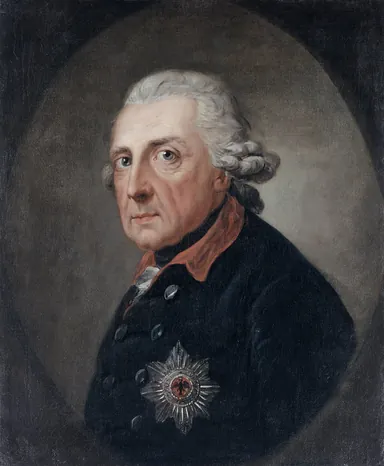
Life of Frederick II of Prussia
A rebellious prince
The son of Frederick William I, the “Soldier King”, Frederick was born in Berlin in 1712. His love of music and French literature clashed with his father’s discipline. In 1730 he tried to flee with his friend Katte, who was executed before his eyes. Once reconciled, he trained in administration and wrote the Anti-Machiavel.
References: Deutsche Biographie · Encyclopaedia Britannica
Silesia
King from 1740, he invaded Silesia that same year, exploiting the succession of Maria Theresa. The two Silesian Wars gave him the province. In the Seven Years’ War (1756–1763) he held out against Austria, France and Russia; the death of Empress Elizabeth and Peter III’s change of sides saved Prussia, which kept Silesia under the Peace of Hubertusburg.
References: Deutsche Biographie · Encyclopaedia Britannica
The philosopher king
He presented himself as the “first servant of the state”. He reformed justice, abolished torture in most cases, promoted agrarian colonisation and religious toleration, and welcomed Voltaire at Sanssouci. He played the flute and composed music. In the First Partition of Poland (1772) he obtained Royal Prussia, which joined his territories together.
References: Deutsche Biographie · Encyclopaedia Britannica
Legacy
He died childless at Sanssouci in 1786 and was succeeded by his nephew Frederick William II. He left a state with a formidable army and an efficient administration, but also a highly hierarchical society with serfdom intact.
References: Deutsche Biographie · Encyclopaedia Britannica
This complete profile is available in English. Bibliographic titles retain their original language. Links marked ES open the Spanish edition.
Key details
Birth: 24 January 1712 Documented
Death: 17 August 1786 Documented
Role: King of Prussia · Elector of Brandenburg
Other recorded names: Frederick the Great · Frederick II of Prussia · Frederick II · Old Fritz
Dynasty: Hohenzollern · ES
Territories: Prussia (ES) · Brandenburg (ES) · Moravia (ES) · Silesia (ES) · Cleves (ES)
Recorded relationships
Their titles over time
Follow the changing territories and offices of Frederick II of Prussia. Each title retains its own status.
Governments in 1741
- Prussian monarchy3 titles and offices
View titles and jurisdictions
- Prussia · ESKing · Effective rule1740–1786
- Brandenburg · ESElector · Effective rule1740–1786
- Cleves · ESDuke · Effective rule1740–1786 · A Hohenzollern duchy from the partition of 1614.
From 1701 the electors of Brandenburg were kings in Prussia; their lands, including Silesia, conquered in 1742, shared a sovereign and an administration. Each territory retains its own title. Source for this grouping
- MoraviaRuler
View titles and jurisdictions
- Moravia · ESRuler · Occupation · Olomouc; capitulation of December 1741 and occupation in 17421741–1742 · Military occupation authority. The municipal history dates the capitulation to 27 December 1741 and the occupation to 1741–1742. It was a temporary occupation; the Silesian cession of 1742 did not make Olomouc a permanent Prussian territory.
- SilesiaRuler
View titles and jurisdictions
- Silesia · ESRuler · Occupation · Regional occupation of Lower Silesia in 1741; it does not anticipate all of Upper Silesia or Glatz1741–1741 · Control was disputed during the conquest. The legal cession and the Prussian territory are shown separately from 1742.
Annual dates: overlap within one year does not prove that two offices were held on the same day. Regencies and co-rulerships retain their labels.
Sources for this profile
- Deutsche Nationalbibliothek · GND authority record · Friedrich II., Preußen, König
- Encyclopaedia Britannica
Biographical and contextual references in their original language. Sources and methodology.
Evidence for this profile
10 recorded claims · 2 without a claim-specific source. Context references do not by themselves verify every fact.
Dates (2/2 with a precise source)
- BirthDocumented
24 January 1712
The authority record gives the birth as 1712-01-24. - DeathDocumented
17 August 1786
The authority record gives the death as 1786-08-17.
Family and relationships (2/2 with a precise source)
- FatherDocumented
Frederick William I of Prussia
The authority record identifies Frederick William I of Prussia (GND 118535978) as father. - MotherDocumented
Sophia Dorothea of Hanover
The authority record identifies Sophia Dorothea of Hanover (GND 118798022) as mother.
Governments (4/6 with a precise source)
- GovernmentPending review
King · Prussia · 1740–1786
A precise source has not yet been added. - GovernmentPending review
Elector · Brandenburg · 1740–1786
A precise source has not yet been added. - GovernmentDocumented
Ruler · Moravia · 1741–1742
Military occupation authority. The municipal history dates the capitulation to 27 December 1741 and the occupation to 1741–1742. It was a temporary occupation; the Silesian cession of 1742 did not make Olomouc a permanent Prussian territory.City of Olomouc · history of the fortress · Swedish occupation of 1642–1650; declared a fortress by Ferdinand III on 15 September 1655; capitulation to Prussia negotiated on 27 December 1741. The municipal history dates the occupation to 1741–1742.City of Olomouc · history of the city · Jobst’s privilege in 1378; loyalty to Sigismund; election of Corvinus in 1469 and agreement of 1479; Frederick of the Palatinate in 1620; Swedish occupation, 1642–1650, and Prussian occupation, 1741–1742; royal confirmation by Maria Theresa in 1762. - GovernmentDocumented
Ruler · Silesia · 1741–1741
Control was disputed during the conquest. The legal cession and the Prussian territory are shown separately from 1742.Geheimes Staatsarchiv Preußischer Kulturbesitz · homage documents of 1741 · I. HA GR Rep. 46 B, Nr. 94–98: homage of Lower Silesia to Frederick II in October and November 1741. Occupation in 1741; legal territorial cession in 1742.City of Wrocław · history · The Duchy of Wrocław (Breslau) was incorporated into the Crown of Bohemia in 1335 after the death of Henry VI; Habsburg from 1526; Prussian conquest in 1741.Głogów County · institutional history · A fief of the Crown from 1329–1331; a hereditary territory of the Crown de facto in 1488 and formally in 1508; Habsburg from 1526; Prussian from 1742. The record begins in 1508 to exclude the earlier Jagiellonian princely governments.City of Opava · history of the city · Partition of 1742: Opava, capital of Austrian Silesia. The outlines of Opava, Krnov and Jeseník/Fryvaldov approximate the southern parts that Austria retained, not the exact river frontier.German Historical Institute · Administrative Divisions, 1780 · Areas of the hereditary provinces, Hungary and the Austrian remnant of Silesia. - GovernmentInferred
Sovereign · Silesia · 1742–1786
Prussian sovereignty after the cession of 1742. Teschen/Bielsko and the southern Austrian parts of Opava, Krnov and Nysa are excluded. Frontier cells are approximate.City of Opava · history of the city · Treaty of Breslau (Wrocław), 11 June 1742: division of Silesia between Prussia and Austria. The River Opava separates the jurisdictions; whole cells of Opava, Hlučín or Krnov are not assigned to the Austrian remnant.Głogów County · institutional history · A fief of the Crown from 1329–1331; a hereditary territory of the Crown de facto in 1488 and formally in 1508; Habsburg from 1526; Prussian from 1742. The record begins in 1508 to exclude the earlier Jagiellonian princely governments.Geheimes Staatsarchiv Preußischer Kulturbesitz · homage documents of 1741 · I. HA GR Rep. 46 B, Nr. 94–98: homage of Lower Silesia to Frederick II in October and November 1741. Occupation in 1741; legal territorial cession in 1742.City of Opava · history of the city · Partition of 1742: Opava, capital of Austrian Silesia. The outlines of Opava, Krnov and Jeseník/Fryvaldov approximate the southern parts that Austria retained, not the exact river frontier.German Historical Institute · Administrative Divisions, 1780 · Areas of the hereditary provinces, Hungary and the Austrian remnant of Silesia. - GovernmentDocumented
Duke · Cleves · 1740–1786
Cleves, held by the Hohenzollerns since 1614, remained with the king of Prussia.
Biographical and contextual references (2)
Editorial history
- 2026-10-12 · Claim registry added; existing historical data kept. Specific sourcing remains to be reviewed.
- 2026-10-08 · Claim registry added; existing historical data kept. Specific sourcing remains to be reviewed.
- 2026-10-04 · Claim registry added; existing historical data kept. Specific sourcing remains to be reviewed.
- 2026-10-04 · Claim registry added; existing historical data kept. Specific sourcing remains to be reviewed.
- 2026-10-03 · Claim registry added; existing historical data kept. Specific sourcing remains to be reviewed.
- 2026-09-30 · The duchy is limited to Dijon and Autun; each other fief now enters the map only under its dated ruler. John III of Namur and the Nevers/Rethel branch were added. The previous shape combined later counties and unrelated lands as if all belonged to the duchy from 1363.
- 2026-09-28 · Claim registry added; existing historical data kept. Specific sourcing remains to be reviewed.
More paths from Frederick II of Prussia
Family
Frederick William I of Prussia · ESKing1688 – 1740Sophia Dorothea of Hanover · ESConsort1687 – 1757Same dynasty
Louisa Ulrika of Prussia · ESConsort1720 – 1782Prince Augustus William of Prussia · ESPrince1722 – 1758Sophie Magdalene of Brandenburg-Kulmbach · ESConsort1700 – 1770Frederick William II of Prussia · ESKing1744 – 1797Wilhelmina of Prussia, Princess of Orange · ESPrincess of Orange1751 – 1820Caroline of Ansbach · ESConsort1683 – 1737In their lifetime
Frederick William II of Prussia · ESKing1744 – 1797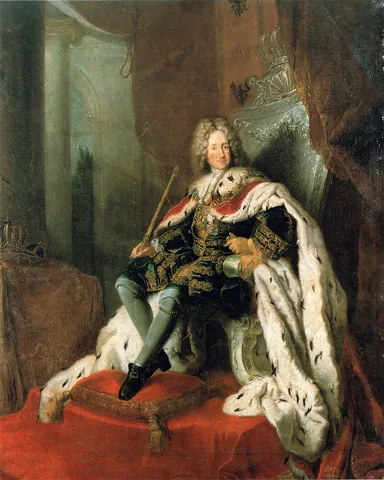 Frederick I of Prussia · ESElector / King1657 – 1713Frederick William III of Prussia · ESKing1770 – 1840
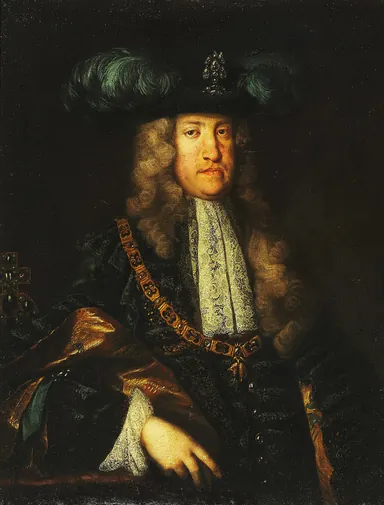 Charles VI, Holy Roman Emperor · ESEmperor1685 – 1740
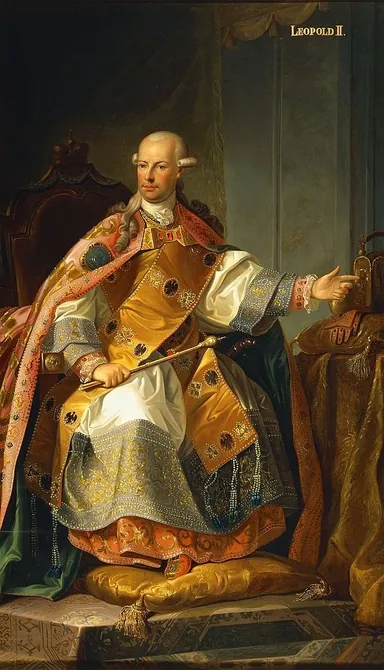 Leopold II, Holy Roman Emperor · ESEmperor1747 – 1792
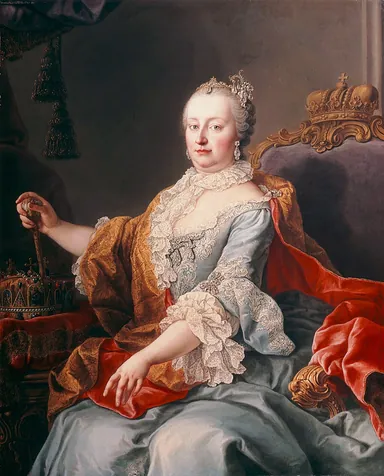 Maria Theresa · ESQueen / Archduchess1717 – 1780